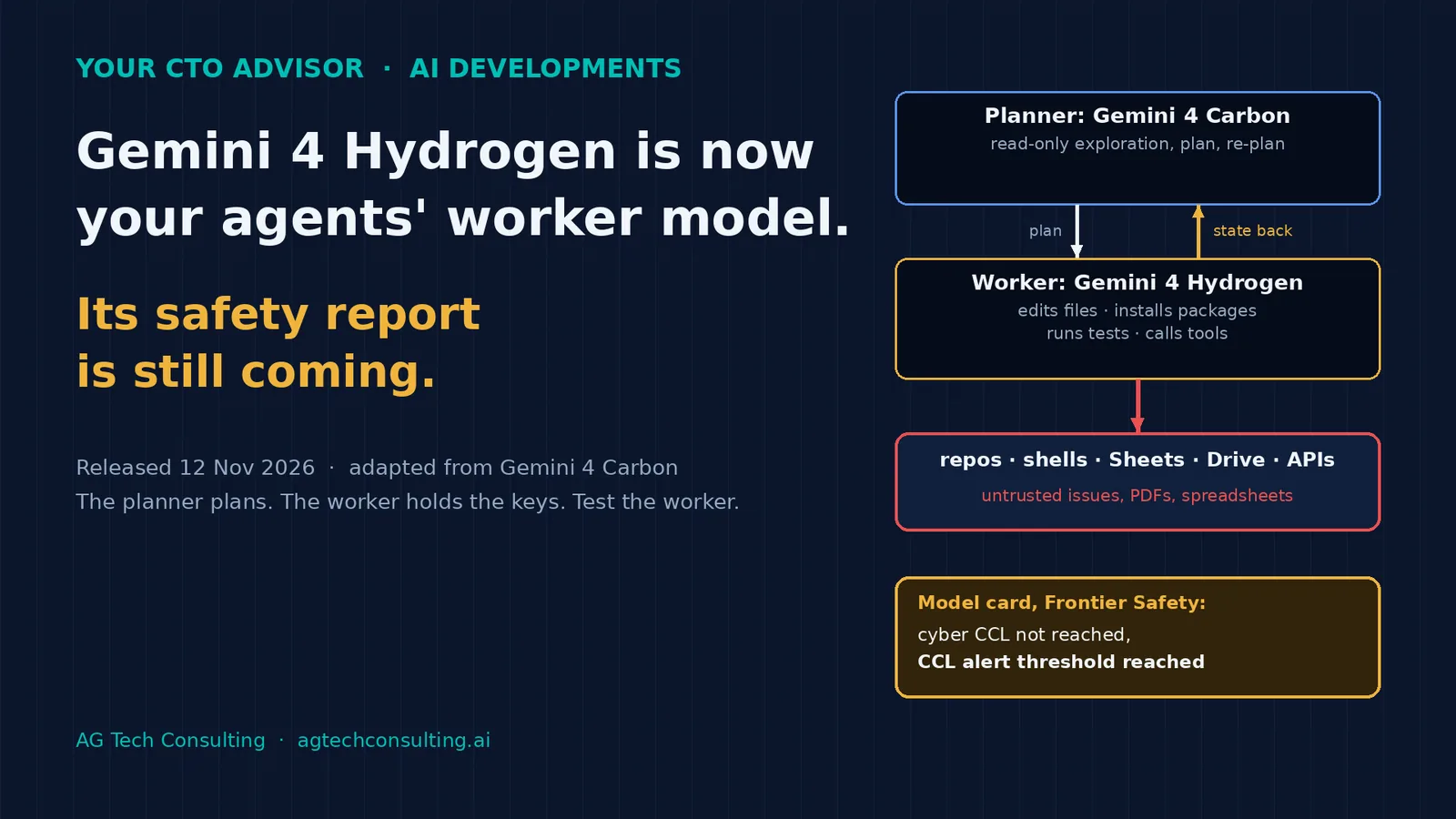
Google released Gemini 4 Hydrogen on 12 November 2026 as the fast model that writes the edits, runs the tests and calls the tools, while Gemini 4 Carbon or Argon does the planning. It is already rolling out across the Gemini API, AI Studio, Gemini for business, Antigravity, Sheets, the Gemini app and Search, yet its own model card says the full Safety & Security Report "will be available in the coming days".
AG Tech Consulting view: if you plan to move agent workloads to Gemini 4 Hydrogen, treat it as the component with its hands on your systems. Run your own prompt-injection and permission tests before switching the model ID, enforce tool permissions outside the model, and wait for the Safety & Security Report before giving it write access to production.
What Google actually shipped
Gemini 4 Hydrogen (gemini-4-hydrogen) is positioned by Koray Kavukcuoglu, SVP of Google DeepMind, as the model "built for rapid execution across diverse agentic workflows". Carbon and Argon remain the frontier models for deep, long-horizon reasoning.
The headline numbers are strong. On the Artificial Analysis Intelligence Index, Hydrogen scores 51 at its default high thinking level, against 50 for Argon, and 54 at the new xhigh level. Pricing is flat across the full 1M-token context: $1.50 per million input tokens and $7.50 per million output tokens.
Against Gemini 3.8 Flash, Google reports Terminal-Bench 4.1 at 57% versus 18.2%, tasks finished 2.5 times faster at the default setting, and fabricated claims cut by more than 5x. In early partner testing, Hydrogen ran 2x to 2.8x faster with 12% to 23% fewer tokens, partly because it batches file-read and search calls in parallel.
The model card adds one important line: "Gemini 4 Hydrogen is adapted from Gemini 4 Carbon." Architecture, training data, hardware and acceptable-use details all point back to the Carbon card. Knowledge cutoff is March 2026.
The API details that change your code
Hydrogen uses the same Gemini 4 API design as Carbon and Argon, so the unified 1,048,576-token window, long decode and the removal of explicit caching and sampling parameters carry over. We covered those when Argon launched. What is specific to Hydrogen deserves a closer look.
Hydrogen offers four thinking levels, low, medium, high and a new xhigh, and it defaults to high. Carbon and Argon default to medium and cap at high. Hydrogen also rejects minimal with an error, so old request templates can fail outright.
A synchronous call returns up to 65,536 tokens per hop, compared with 32,768 per non-streaming REST hop on Carbon and Argon. Longer output needs background: true, where Google's servers continue in 64K hops.
Two rules in the migration guide matter for security teams. Tools must be declared natively through function calling, because raw-text JSON tool calls with no declared tools can fail as MALFORMED_FUNCTION_CALL. And thought signatures must be returned unchanged across turns, never copied across parallel functionCall parts.
Let us be very clear: a model swap that changes the default reasoning depth, the tool-call format and the per-hop output limit is not a drop-in replacement. It is a behaviour change, and behaviour changes need tests.
How orchestration works, and why it matters
The bigger change is architectural. Google is not only selling a faster model; it is selling a division of labour between a planner and a worker.
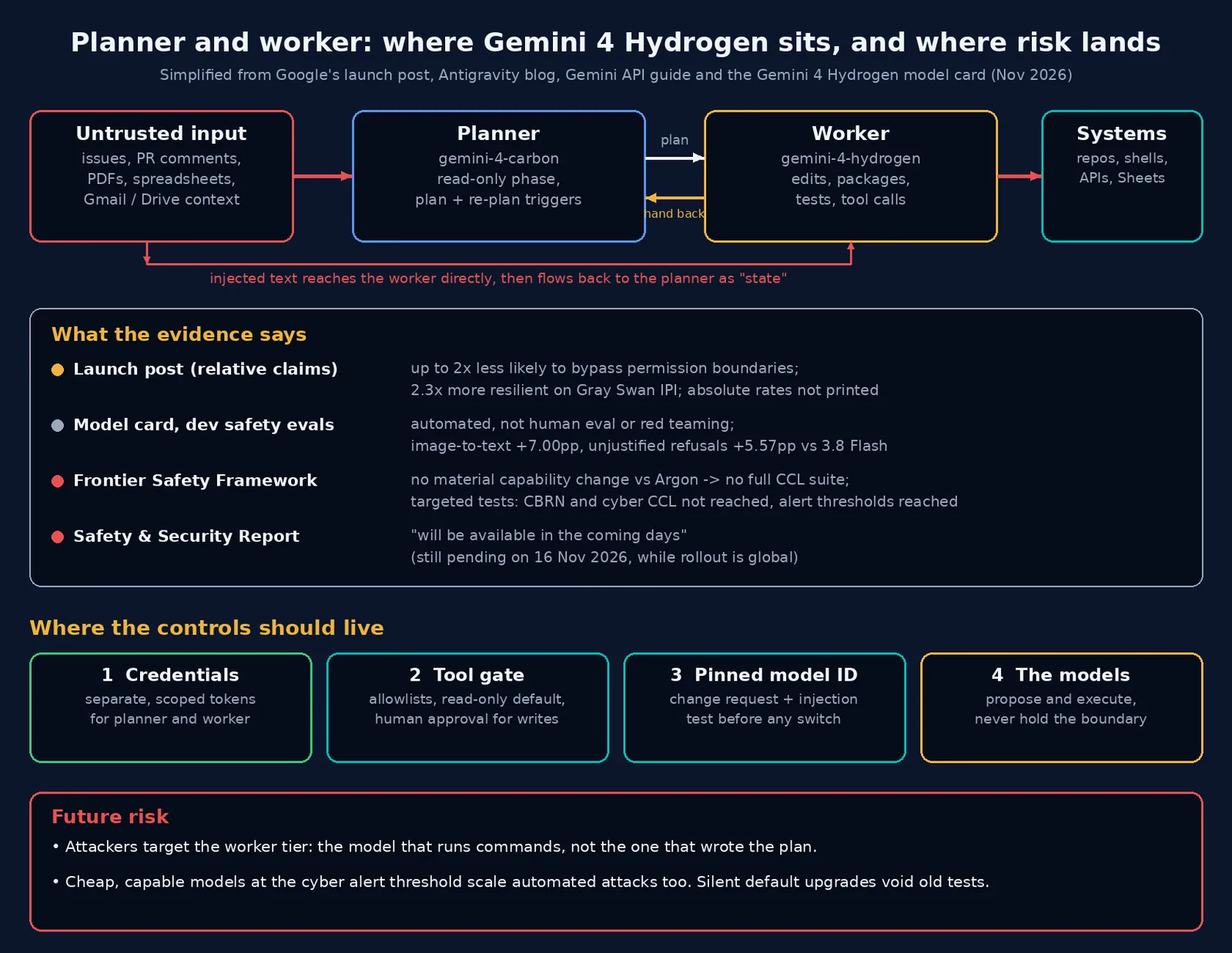
In Google Antigravity, a new Orchestrator mode switches between Carbon and Hydrogen inside the same session. Google's Antigravity blog describes the pattern: Carbon can start in a read-only phase to explore dependencies and build a plan with re-planning triggers. Hydrogen then takes over to write edits, update packages and run tests. If Hydrogen hits friction, it hands back to Carbon.
Google reports that Orchestrator reached near-Carbon task success on Terminal-Bench while using on average 24% less quota and finishing 19% faster. For parallel work, Carbon can coordinate while Hydrogen powers "worker and verifier agents" across isolated workspaces. Google says tens of thousands of swarms were launched on Antigravity within a couple of days.
The same split is available to developers. Through the Gemini API, planning turns can go to gemini-4-carbon and execution turns to gemini-4-hydrogen in one session using previous_interaction_id. The Antigravity agent in Gemini Managed Agents now uses Hydrogen by default.
Notice who does what in Google's own issue-triage demo built with the Antigravity SDK. Hydrogen agents triage issues, search the codebase and iterate on pull-request comments. The Carbon agent is assigned larger refactors, new features and security checks.
The point is simple: the cheaper, faster model is the one reading untrusted issues, touching files, installing packages and running commands. That is exactly where prompt injection lands.
What the safety evidence says, and what it does not
Google's launch post makes several agent-safety claims. Hydrogen reduces overreach in agentic tasks by up to 81%, cuts misaligned actions and task shortcutting by 12x, and is "up to 2x less likely to bypass permission boundaries" when faced with impossible or blocked tasks. Against indirect prompt injection, Google says it is "more than 2.3x more resilient on the Gray Swan IPI benchmark".
These are welcome improvements, but read them carefully. Every figure is relative to an earlier model, and the absolute rates are not printed. "Less likely to bypass permission boundaries" still means the model sometimes tries.
The model card is more measured. Its development safety results are "automated evaluations and not human evaluation or red teaming". Compared with Gemini 3.8 Flash, image-to-text safety improved by 7.00 percentage points, while unjustified refusals rose by 5.57 points, "particularly for multimodal prompts".
On frontier risk, Google ran a Material Capability Change assessment under its April 2026 Frontier Safety Framework. Hydrogen showed no material increase in general capability over Argon, so "a full suite of critical capability evaluations was not required".
Because Google could not rule out that Argon and Carbon had reached the biological CBRN and cybersecurity Critical Capability Levels, it ran targeted tests on Hydrogen. The result: Hydrogen does not reach the CBRN or cyber CCLs, "though it reaches the CCL alert thresholds for both domains".
For loss-of-control stealth and situational awareness, capability testing was not required. Google says it applies control, monitoring and model security mitigations "as if the TCL had been reached, as a conservative assumption".
So the safety case is partly inherited from Carbon and Argon, the cyber alert threshold is reached, and the detailed report is still pending while the model is live for everyone. That is not a scandal. It is a reason to do your own homework.
Future security risks
The worker tier becomes the attack surface. When planners plan and workers act, attackers will target the worker. Injected text in an issue, a PDF or a spreadsheet only has to steer the model that runs npm install or edits a config file, not the one that wrote the plan.
Context crosses model boundaries. Orchestrator hands state back and forth between Carbon and Hydrogen in one session. Content poisoned during a Hydrogen execution step can return to Carbon as "observed state" and shape the next plan, including the security checks Carbon is supposed to perform.
Cheap capability scales misuse too. A model that sits at the cyber CCL alert threshold, priced at $1.50 per million input tokens and available on a free API tier, lowers the cost of automated reconnaissance and exploit iteration. Defenders should assume attackers are running swarms as well.
Silent upgrades shift behaviour. Managed agents now default to Hydrogen, and free Gemini app users reach it through auto model selection. When the model under an agent changes without a deliberate decision, every prompt-level guardrail you tuned on the old model needs retesting.
Checklist for CTOs and CISOs
Inventory every agent, workflow and SDK call that uses a Gemini model, and record which ones now default to gemini-4-hydrogen. Pin model IDs in production; switch to Hydrogen only through a change request with a test run attached. Re-run your prompt-injection suite on Hydrogen with your own documents, issues and spreadsheets, not only vendor benchmarks. Enforce tool permissions outside the model: allowlisted commands, scoped tokens, read-only defaults and human approval for writes. Give worker agents the least privilege: separate credentials for planner and worker, and no secrets in workspaces that read untrusted content. Declare every tool natively through function calling, set thinking_level explicitly, and retire any guardrail that parsed raw-text JSON tool calls. Log every model switch and tool call in orchestrated sessions, with the model ID that made each decision. Treat content returned from execution steps as untrusted when it flows back to the planner model. Read the Gemini 4 Hydrogen Safety & Security Report when it is published, especially the cyber and prompt-injection sections, before widening access. Brief your security team that capable, low-cost models are available to attackers too, and update threat models for automated, high-volume attempts.
The bottom line
Gemini 4 Hydrogen is a serious release: frontier-class scores at a worker-class price, built to sit under a planner and do the actual work. That is precisely why it deserves more scrutiny, not less.
This is the need of the hour: decide deliberately which model holds the keys, keep the permission boundary outside the model, and test the worker as hard as you test the planner.
Sources
https://blog.google/innovation-and-ai/models-and-research/gemini-models/introducing-gemini-4-hydrogen/ https://storage.googleapis.com/deepmind-media/Model-Cards/Gemini-4-Hydrogen-Model-Card.pdf https://aistudio.google.com/docs/whats-new-gemini-4-hydrogen https://antigravity.google/blog/gemini-4-hydrogen-in-google-antigravity https://blog.google/innovation-and-ai/technology/developers-tools/build-with-gemini-4-hydrogen/
Also on our website: https://agtechconsulting.ai/insights/gemini-4-hydrogen-worker-model.html
Putting a fast worker model like Gemini 4 Hydrogen under your agents and want an independent review of the permissions around it? Email avinash@agtechconsulting.ai, visit agtechconsulting.ai, or book a 30-minute call: https://calendly.com/avinash-dubey-30-min-catchup/meeting-with-ag-tech
Thanks for the work and insights: Google DeepMind Google Google Cloud Google Workspace Google AI Studio koray kavukcuoglu Demis Hassabis Sundar Pichai Logan Kilpatrick Artificial Analysis OWASP GenAI Security Project NIST University CISA Anthropic OpenAI National Institute of Standards and Technology (NIST) Cloud Security Alliance
Originally published on LinkedIn in the Your CTO Advisor newsletter: read and comment on LinkedIn →