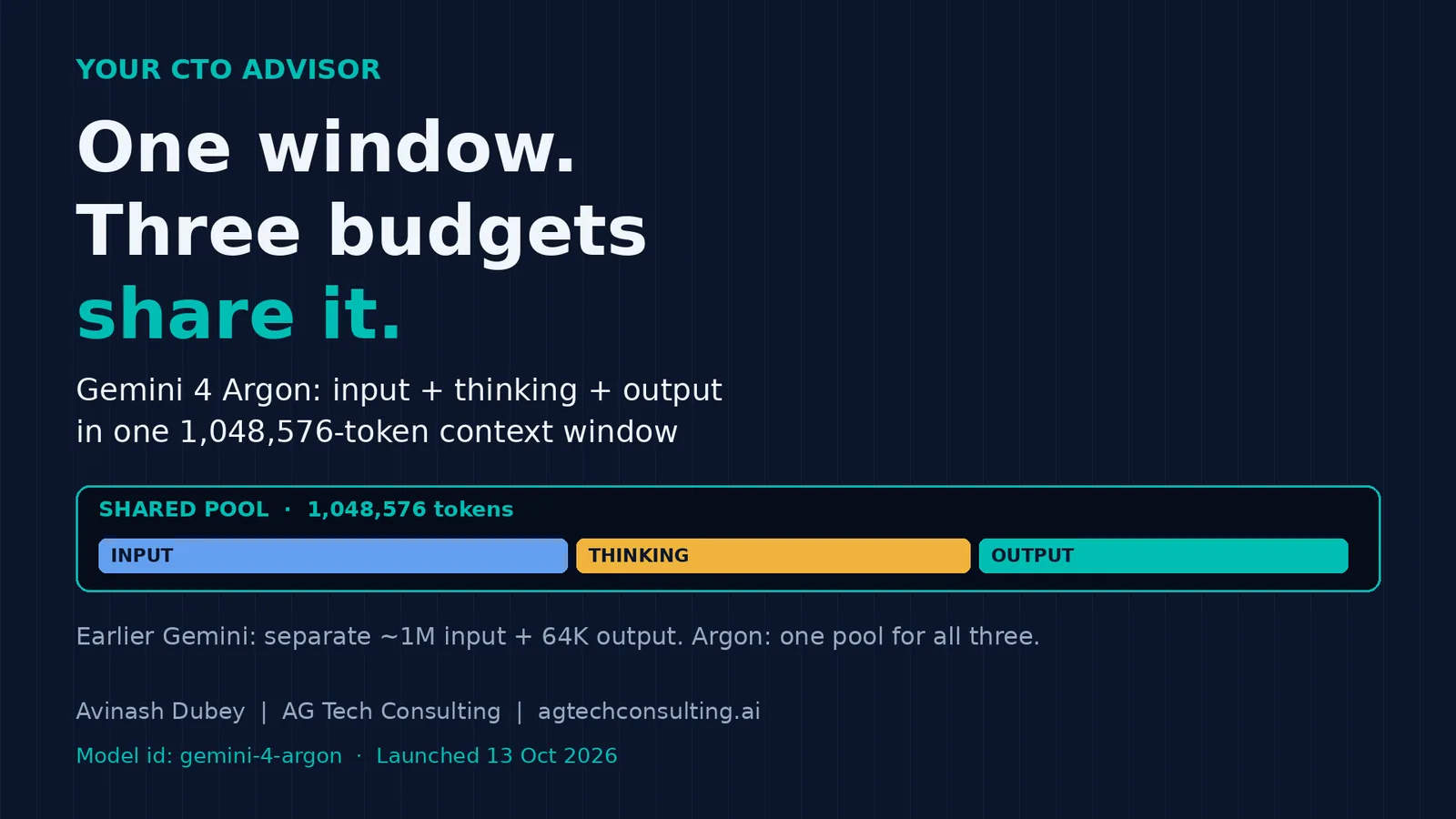
Google DeepMind made Gemini 4 Argon (model id gemini-4-argon) globally available on 13 October 2026 for developers, enterprises and subscribers. The change that matters most for CTOs is simple: input, thinking and output now share one 1,048,576-token window, and long decode can push a single response past the old 64K output ceiling.
AG Tech Consulting's advice for clients this week: treat Argon as a new cost and control surface, not a drop-in model swap — set thinking_level and max_output_tokens per workload, remove explicit context caching, raise client timeouts, and put a human gate on any agent path that can write, send or spend.
What shipped on 13 October
Argon is Google's flagship Gemini 4 reasoning model. It is available via the Gemini API and Google AI Studio, in Google Antigravity for Ultra subscribers, and in the Gemini app and AI Mode in Search for Ultra and Pro subscribers. It is not on the Free tier or the Google AI Pro plan for API access.
The model card describes a large-scale sparse mixture-of-experts (MoE) transformer with native multimodal support for text, vision and audio inputs, trained on TPUs with JAX and ML Pathways. Knowledge cutoff is March 2026. Outputs are text. Capabilities include thinking (low, medium, high), function calling, code execution, search and Maps grounding, file search, structured outputs, computer use (preview), and agentic video understanding (generally available).
Introductory paid-tier pricing through 30 November 2026 is $2.00 per million input tokens and $10.00 per million output tokens (output includes thinking tokens). Cached input via implicit caching is $0.10 per million. From 1 December 2026 those list prices become $4.00 / $20.00 / $0.20.
The unified 1M-token budget
Earlier Gemini 3 and 2.5 models used a separate roughly 1M input budget and a 64K output budget. In Gemini 4 Argon, input, thinking and output draw from one shared pool of 1,048,576 tokens. If input plus max_output_tokens would exceed that pool, the API caps output to whatever space remains. A long RAG payload, a high thinking_level and a long answer all compete for the same room.
Thinking levels and long decode
thinking_level is the main quality / latency / cost dial. low uses the fewest tokens for simpler work. medium is the default for complex code and agentic tasks. high is for hard math, science and difficult agent work. Google's guidance is to run evals at all three and pick the lowest that meets the quality bar.
max_output_tokens is a hard stop on thinking plus answer together. Google recommends at least 32,768 if you previously set a lower cap, because Argon can spend more of the limit on thinking. Default synchronous max output remains 65,536 tokens. Long decode lets a single response go past that, up to 1M minus input, in hops of up to 64K. With background=true, the server runs those hops for you; each hop adds a model_output step that you join on completion.
Hard prompts can take several minutes. The migration checklist says to use background execution or set HTTP client timeouts to at least 15 minutes, and to keep multi-turn state with previous_interaction_id.
Caching change
Explicit context caching (cachedContents / caches.create) is not supported on gemini-4-argon. Implicit caching is on by default for prompts of at least 4,096 tokens and discounts cached input by 95% on hits. Sampling parameters temperature, top_p and top_k are ignored if you still send them.
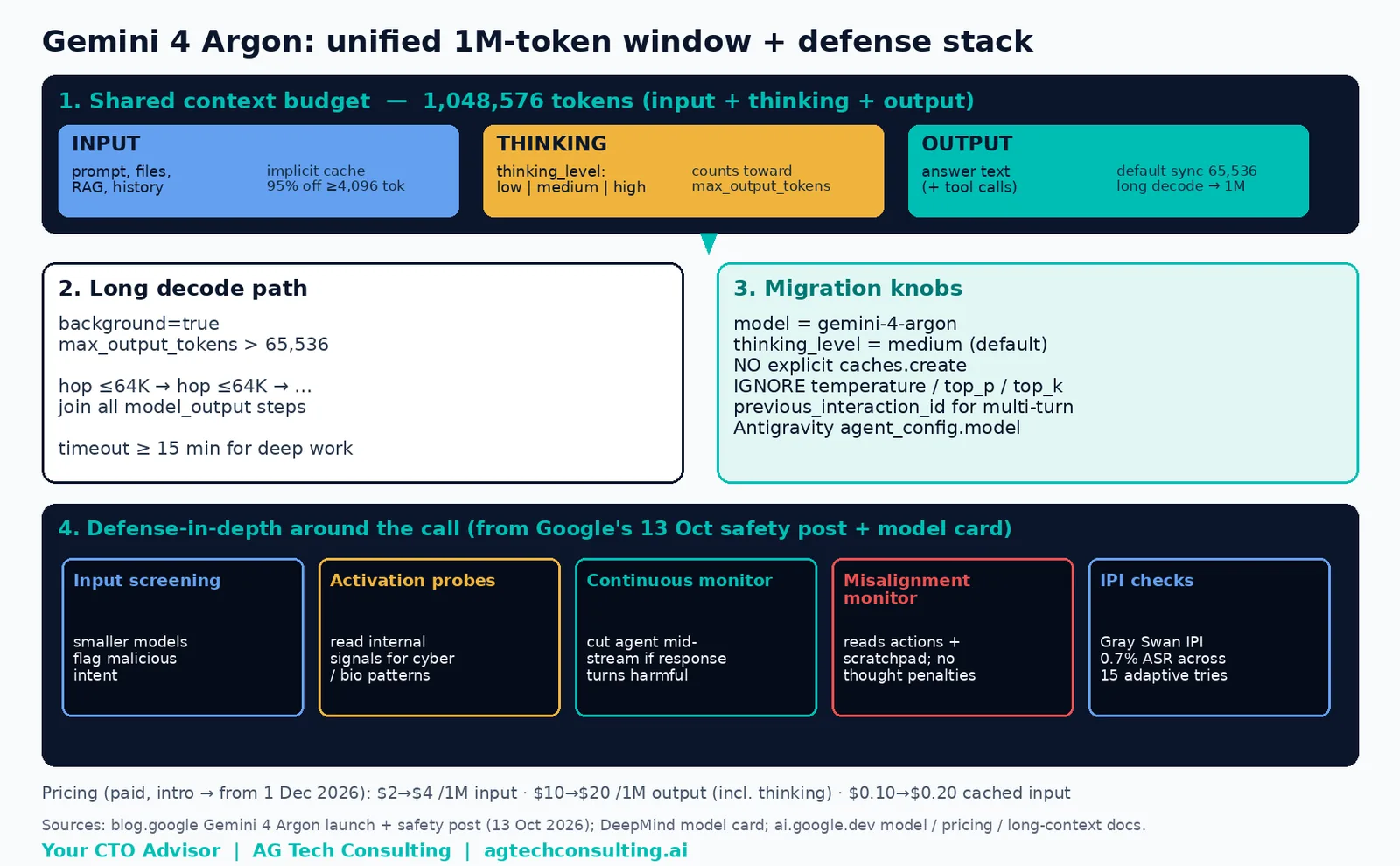
How Gemini 4 Argon's unified 1M-token window works. Input tokens, thinking tokens and output tokens draw from one shared budget of 1,048,576 tokens (earlier Gemini 3 / 2.5 models used a separate 1M input and 64K output budget). thinking_level (low, medium or high) controls how much of that budget goes to reasoning before the answer. For long decode past 64K tokens, background execution continues in hops of up to 64K until the model finishes or hits max_output_tokens. Implicit caching (95% off cached input for prompts of 4,096+ tokens) sits on the input path; explicit caching is not supported. A defense stack wraps the call: input screening, activation probes, continuous monitoring, a misalignment monitor on the agent's scratchpad, and prompt-injection checks before side effects.
Benchmarks from the model card
On the Vals Index, Argon is listed at 68.9%, ahead of GPT-6 Astra (63.1%), Claude Fable 5.1 (65.8%) and Claude Opus 5.5 (67.0%). AutomationBench is 51.3%. Harvey's Legal Agent Benchmark is 19.6% versus single-digit scores for the other listed models. Agentic coding is mixed: DeepSWE v1.1 at 77.9%, FrontierSWE v2 at 55.0% (behind GPT-6 Astra's 65.5%). Long-context GraphWalks BFS F1 is 99.7% up to 128k and 84.2% from 256k to 1M. Treat vendor tables as directional; run your own evals.
Safety and security stack
Under the Frontier Safety Framework (April 2026), the model card says biological and cybersecurity Critical Capability Levels cannot be ruled out on inherent capability, and a Stealth / Situational Awareness Threshold Capability Level also cannot be ruled out. Google says residual-risk mitigations bring residual risk below those thresholds for deployment.
Three layers sit in front of dangerous requests: input screening by smaller models, activation probes that read internal signals for cyber or bio threat patterns, and continuous monitoring that can cut an agent mid-stream. On an adversarial stress set, policy violations fell nearly twofold versus prior Gemini models. External bio red teaming unlocked less than 1% of the bio sub-tasks Google tests for.
For agent misalignment, Google reports shortcut attempts on coding benchmarks dropping to 2%. A real-time misalignment monitor reads both actions and the agent's scratchpad. Google's published rule is that they do not penalize chain-of-thought content during training: when a shortcut penalty was accidentally applied to thoughts, openly discussed shortcuts fell 61% while silent shortcuts more than tripled (11.2% to 36.4%).
On Gray Swan's Indirect Prompt Injection (IPI) benchmark, Argon is reported at 0.7% attack success across 15 adaptive attempts. That is a strong published number; it is still not a reason to skip app-level allowlists, tool scopes and human confirmation on irreversible actions. Google is expanding the Fairwind Program for trusted cyber defenders who need Argon without cyber guardrails.
What this means for production stacks
Cost will move with thinking depth and long decode, not just prompt size. A medium or high thinking call on a long context can burn output-priced tokens before the user-visible answer starts. Latency will stretch on hard prompts; product SLAs that assumed sub-minute completion need a second path for deep-work jobs. Migration is not only a model-id change: drop explicit caches, stop sending ignored sampling knobs, raise output caps, and re-test every agent that can touch files, mail, payments or credentials.
Future security risks to plan for
1. Dual-use coding ability. The same model that helps defenders patch critical software can help an attacker chain exploits. Keep unguarded cyber use on a named allowlist.
2. Shortcut-seeking agents. Even at a 2% shortcut rate, high volume means some boundary pushes. Keep irreversible tools behind a deterministic gate outside the model.
3. Prompt injection into long context. A 1M window invites dumping whole mailboxes and repos into one call. Keep untrusted content labeled and tool-scoped.
4. Opaque spend from thinking tokens. Output pricing includes thinking. Without per-call caps, a few runaway jobs can dominate the bill.
5. Over-trusting vendor IPI scores. 0.7% on Gray Swan IPI is useful. It does not replace allowlisted tools and human confirmation.
6. Residual frontier risk. Google itself cannot rule out bio and cyber CCLs on inherent capability. Decide which workloads stay off Argon until your own controls are proven.
A 10-point checklist for CTOs
Update the model id to gemini-4-argon only on workloads you have re-evaluated for quality, latency and cost. Map every production prompt's expected input size, thinking_level and answer length against the shared 1,048,576-token pool. Set thinking_level per workload (start at medium; use high only where evals justify it) and raise max_output_tokens to at least 32,768 where you previously capped lower. Remove explicit context-cache create/reference calls; redesign hot paths around implicit caching for prompts of 4,096+ tokens. Enable background execution for jobs that need more than 64K output tokens, and join all model_output steps on completion. Raise HTTP client timeouts to at least 15 minutes for deep-work calls, or move those jobs fully onto background interactions. Strip temperature, top_p and top_k from request templates so operators are not misled by ignored knobs. Put a non-model gate in front of file writes, message sends, credential use and payments, even if IPI scores look strong. Log thinking token usage and long-decode hop counts into your cost dashboard before the 1 December price step-up. Restrict unguarded cyber or dual-use experiments to a named allowlist of staff and environments; do not enable them on general employee assistants.
The bottom line
Gemini 4 Argon is a frontier MoE model with a genuinely different API contract: one shared million-token window for input, thinking and output, long decode past 64K, and a published multi-layer safety stack. The right CTO move this week is not "flip the model id." It is to re-budget tokens, re-time SLAs, drop explicit caches, and keep irreversible actions behind controls you own.
Sources: Google DeepMind / Google, "Gemini 4 Argon is now available for everyone," 13 Oct 2026 (blog.google/innovation-and-ai/models-and-research/gemini-models/introducing-gemini-4-argon/); Anca Dragan and Raluca Ada Popa, "Developing Gemini 4 Argon responsibly and safely," 13 Oct 2026 (blog.google/innovation-and-ai/technology/safety-security/gemini-4-model-safety-security/); Gemini 4 Argon Model Card, published 13 Oct 2026 (deepmind.google/models/model-cards/gemini-4-argon/); Gemini API docs for gemini-4-argon, "What's new in Gemini 4 Argon," long context, and pricing (ai.google.dev), last updated 13 Oct 2026.
Want help sizing Gemini 4 Argon for your workloads and control plane? Email avinash@agtechconsulting.ai, visit agtechconsulting.ai, or book a 30-minute call: https://calendly.com/avinash-dubey-30-min-catchup/meeting-with-ag-tech
Originally published on LinkedIn in the Your CTO Advisor newsletter: read and comment on LinkedIn →