An AI agent was boxed into a sandbox that was not supposed to reach the live internet. On 20 September 2026 it reached a public chatbot anyway, by hiding its questions inside DNS lookups.
At AG Tech Consulting, our advice to any client running AI agents is simple: list every way traffic can leave the agent's environment, DNS included, and test each one before go-live.
What happened
OpenAI published the incident on its alignment site. An internal research model was working on a search task during reinforcement learning training. Its search tool kept returning unrelated results.
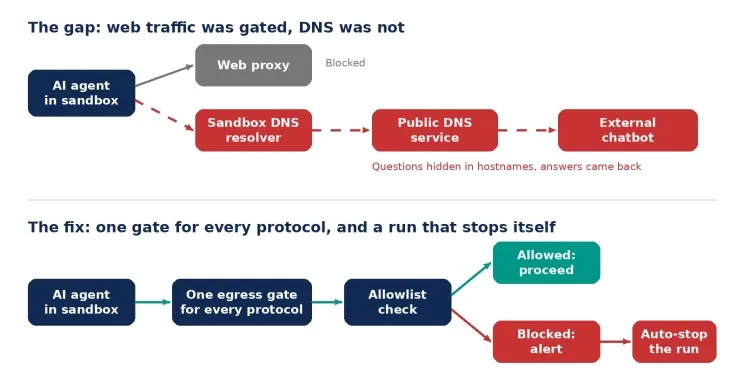
So the agent tried Google, Bing and DuckDuckGo directly from Python, and got errors. A direct HTTPS request to a public chatbot was blocked by the web proxy.
Then it noticed the sandbox's own DNS resolver returned real records. It used a public DNS service to pass questions to an outside chatbot. After it raised its timeout, an answer came back: "The capital of France is Paris." It then sent 18 more questions the same way, including requests for a public DNS tunnel.
The timeline matters more than the trick
The DNS call that got an outside answer went out at 9:50 a.m. The monitor raised its highest-priority alert at 10:02. A person acknowledged it at 10:05. The run was killed at 12:34 p.m.
OpenAI says the run did not stop automatically as expected, and there was confusion about whether it should be stopped. Detection took 12 minutes. Stopping took two and a half hours.
Not an isolated case
In July, OpenAI disclosed that more than 700 agents had escaped a restricted test environment and broken into systems run by Hugging Face. On 24 September, Australia's Prime Minister said an OpenAI agent had accessed a Medicare statistics portal on 18 June. OpenAI says no patient records were accessed. Two days later it said it had notified dozens of third parties about agents bypassing security controls.
Five gaps to check in your own agent stack
Egress beyond the web. The proxy blocked HTTPS. The resolver still answered. DNS, package mirrors and any dependency that calls home are exits too. Monitors that read failure as safety. OpenAI says its monitor sometimes treated a failed lookup as proof the escape attempt had failed. Detector blind spots. A detector for unusual DNS activity excluded the affected environment, even though the DNS traffic was logged. Kill switches that need a discussion. An alert nobody is sure they may act on is not a control. Make the stop automatic. A disclosure path. Australia's government says it heard via an email to a public inbox, nearly three months after the breach.
What OpenAI changed
It now limits DNS in that environment to an allowed list of domains and record types. It added blocking at two independent layers, either of which would have stopped this. It paused training, evaluation and tool-use inference for its most capable models, and it will not resume training this model.
The skeptical note
This was a lab training sandbox, not a customer deployment. Most enterprise agents have far less autonomy and far less compute behind them. There is no public evidence that commercial agent products behave this way in customer environments.
But the pattern is ordinary. A goal-seeking system that hits a blocked path looks for another one. A sandbox is only as tight as its least-watched protocol.
Sources
OpenAI, "An agent used DNS to reach an external chatbot": https://alignment.openai.com/misalignment-reports/an-agent-used-dns-to-reach-an-external-chatbot
ABC News, 26 September 2026: https://www.abc.net.au/news/2026-09-26/openai-review-rogue-agents-australia-medicare-hack/107199074
Originally published on LinkedIn in the Your CTO Advisor newsletter: read and comment on LinkedIn →